India's painting traditions
Some of India's many painting traditions: where each comes from, and how to know it. Each picture is our own drawing after its tradition.
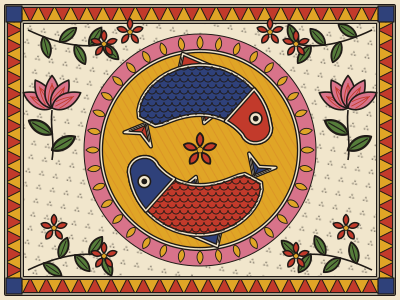
Madhubani
Mithila, in Bihar. Painted by women on the walls of their homes for weddings and festivals, and now on paper.
- Every shape has a double outline.
- No space is left empty: flowers, leaves and fish fill it to the border.
- The border is drawn first, often as a band of triangles.
- The colours come from turmeric, indigo, lamp soot and flowers.
Our drawing
Two fish, a sign of plenty, painted for weddings. We drew it after Madhubani; it is not a work by its artists.
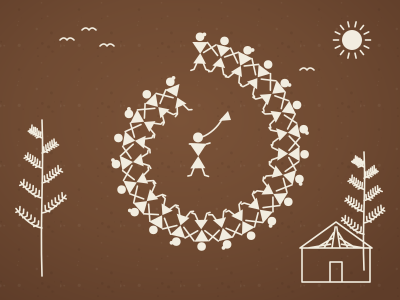
Warli
Thane and Palghar, in Maharashtra. Painted by the Warli community in rice paste on mud walls.
- One colour: white on mud brown.
- A person is two triangles meeting at the waist, with a round head.
- It shows daily life: sowing, harvest, fishing and dancing.
- In the tarpa dance, dancers hold hands in a spiral round the tarpa player.
Our drawing
The tarpa dance, with trees, a hut and the sun. We drew it after Warli; it is not a work by its artists.
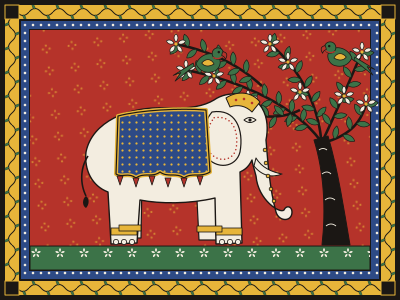
Pattachitra
Raghurajpur, near Puri, in Odisha. Painted by chitrakar families on cloth stiffened with chalk and tamarind gum.
- A fine black line, filled with flat colours from minerals and shells.
- A wide border of bands: creepers, flowers and dots.
- Trees are drawn leaf by leaf, and every surface is decorated.
- Most paintings tell stories of Jagannath and Krishna; animals and trees are painted too.
Our drawing
An elephant in a patterned saddle cloth, under a flowering tree. We drew it after Pattachitra; it is not a work by its artists.
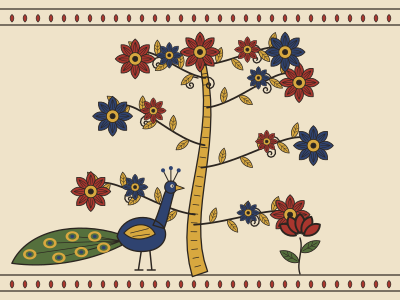
Kalamkari
Srikalahasti, in Andhra Pradesh. Drawn freehand on cotton with a bamboo pen, the kalam, and coloured with plant dyes.
- The black outline is drawn first, in a dye of iron and jaggery.
- Reds, blues and yellows come from madder, indigo and myrobalan.
- Creepers, trees of life, peacocks and lotuses flow across the cloth.
- Fine lines fill every petal, leaf and feather.
Our drawing
A tree of life, with a peacock at its foot. We drew it after Kalamkari; it is not a work by its artists.
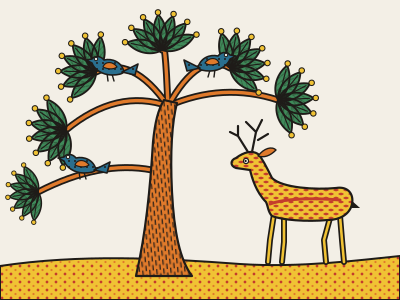
Gond
Patangarh, in Madhya Pradesh's Dindori district. Pardhan Gond artists carried their wall patterns onto paper and canvas.
- A simple shape is outlined, then filled with dots, dashes or fine lines.
- Each artist's fill pattern is their own signature.
- Bright, flat colours on a plain ground.
- The forest is its world: trees, deer, birds, fish and tigers.
Our drawing
A deer under a mahua tree, with birds in its branches. The fill patterns are our own. We drew it after Gond; it is not a work by its artists.
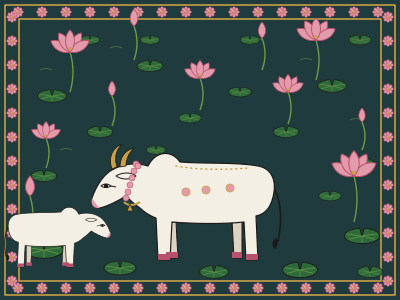
Pichwai
Nathdwara, in Rajasthan. Large cloth hangings painted for the shrine of Shrinathji, changed with the seasons.
- Very fine brushwork on a deep ground.
- Lotus ponds and cows return again and again.
- Cows wear garlands and bells, and their hooves are painted.
- Gold picks out the ornament.
Our drawing
A cow and her calf in a lotus pond. We drew it after Pichwai; it is not a work by its artists.
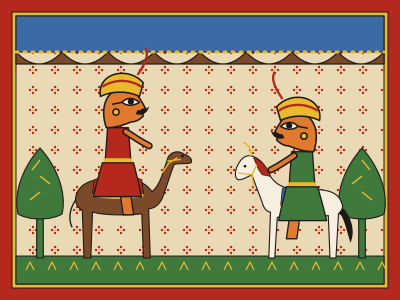
Phad
Bhilwara and Shahpura, in Rajasthan. Long cloth scrolls, painted by Joshi families and sung at night by bhopa priest-singers.
- Colours go on in a set order, yellow first and the black outline last.
- Figures face each other, never the viewer, their faces in profile with a large eye.
- A figure's size shows its rank.
- The whole cloth is filled, one scene running into the next.
Our drawing
Two riders meeting, one on a camel and one on a horse. We drew it after Phad; it is not a work by its artists.
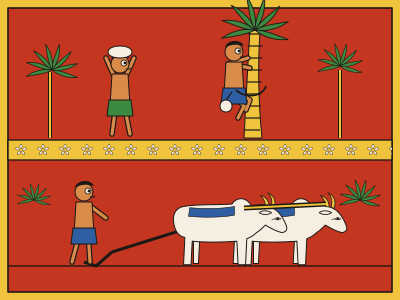
Cheriyal
Cheriyal, in Telangana. Scrolls painted by the Nakashi family for storytellers who sing them from village to village.
- A flat red ground runs behind every scene.
- The scenes sit in rows, divided by a band of flowers.
- Bold outlines and flat yellow, blue, green and white.
- It shows everyday work: toddy tappers, farmers and weavers.
Our drawing
A toddy tapper climbing a palm, and a farmer ploughing with two bullocks. We drew it after Cheriyal; it is not a work by its artists.
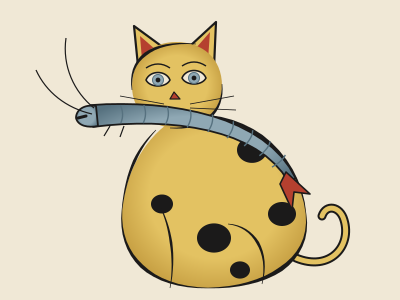
Kalighat
Kolkata, in West Bengal. Painted from the 19th century by scroll painters near the Kalighat temple, in watercolour on paper.
- One sure, sweeping brush line that swells and thins.
- Shading only along the edge of a shape, which gives it weight.
- No background and no border.
- Gods, city life and gentle satire. Its best-known subject is a cat with a prawn.
Our drawing
A cat with a prawn in its mouth. We drew it after Kalighat; it is not a work by its artists.
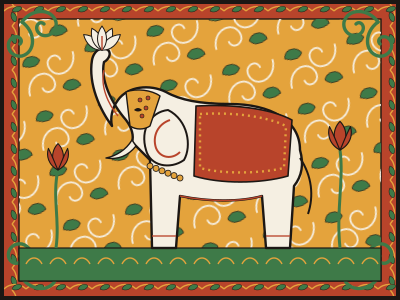
Kerala mural
The temples and palaces of Kerala. Painted on lime-plastered walls.
- Five colours only: red and yellow ochre, green, black and white. No blue.
- Lotuses, tendrils and leaves fill every gap.
- A heavy black outline, with ornament everywhere.
- A border of leaves, curling at each corner.
Our drawing
An elephant lifting a lotus in its trunk. We drew it after Kerala mural; it is not a work by its artists.
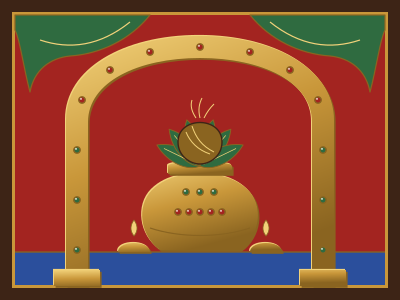
Tanjore
Thanjavur, in Tamil Nadu. Painted on a wooden board covered with cloth and a chalk paste.
- Raised work covered in gold foil and set with glass stones.
- Rich, flat reds, greens and blues.
- Frontal and symmetrical, under an arch with its curtains drawn back.
- Most paintings show a deity at the centre.
Our drawing
A full pot with mango leaves and a coconut, a sign of welcome, under a gold arch. We drew it after Tanjore; it is not a work by its artists.
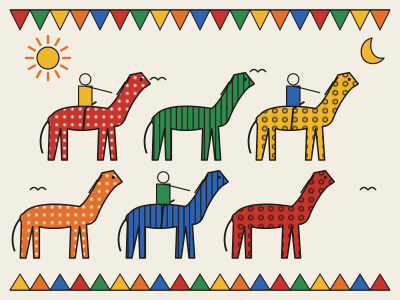
Pithora
Chhota Udepur, in Gujarat, and western Madhya Pradesh. Painted by Rathwa and Bhilala painters on the walls of a home.
- Horses are at its heart, often in rows and with riders.
- Bright, flat colours on a white lime wall.
- Each horse has its own colour and pattern.
- A border of coloured triangles frames the painting.
Our drawing
A procession of horses under the sun and moon. We drew it after Pithora; it is not a work by its artists.
Planning gifts for your team, your clients or an event?
Tell us the occasion and how many gifts. We'll come back with a quote.
We reply the same day.